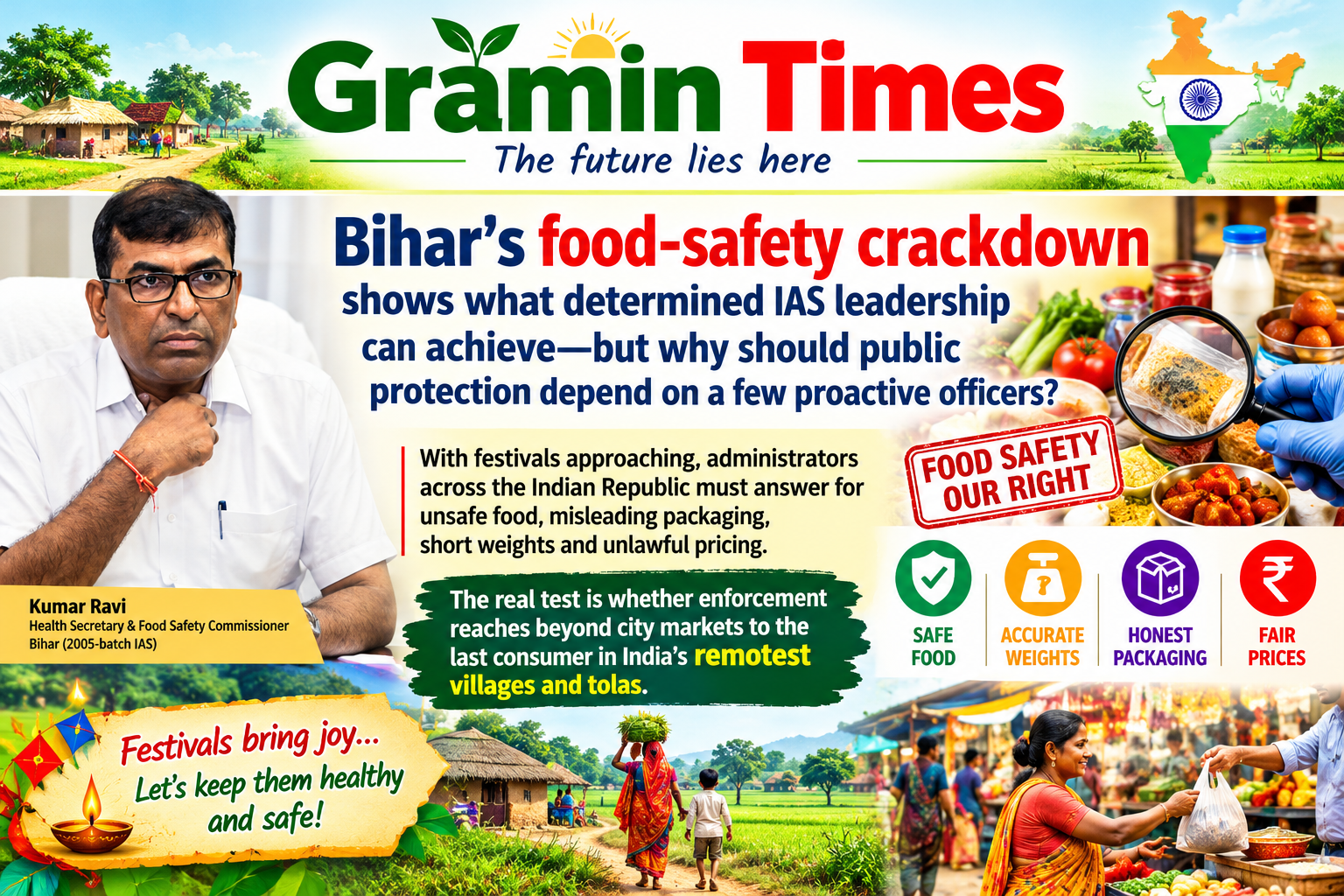
The Bihar food-safety drive has exposed a larger question for India’s administrative leadership: if a determined officer can intensify enforcement, why should consumers in other states continue to wait? With the festival season approaching, senior administrators must prove that safe food, honest weights, proper packaging and fair prices are priorities—not occasional publicity exercises.
By Ganesh Upadhyay, Senior Journalist
MUMBAI/PATNA October 26, 2026, Monday: A government’s administrative strength is not measured only by the files it clears, the meetings it holds or the schemes it announces. It is measured by whether an ordinary citizen can buy unadulterated milk, safe sweets, correctly packaged groceries and fairly weighed essentials without risking the family’s health or household budget. That is the test now facing India’s senior administrative leadership.
Bihar has taken a step in that direction. Under Kumar Ravi, Bihar Health Secretary and Food Safety Commissioner, a 2005-batch IAS officer, the state has intensified its food-safety enforcement campaign. The initiative has drawn attention partly because Ravi is a batch mate of Tukaram Mundhe, Maharashtra FDA Commissioner, whose enforcement approach has become a point of comparison in discussions about food regulation.

The important question is no longer whether Bihar’s campaign deserves recognition. It does. The question is why the protection of consumers should depend so heavily on whether a particular officer chooses to act—and whether other senior administrators across the Indian Republic will follow through.
Official figures cited for a recent three-month period show that Bihar conducted 531 inspections across all 38 districts. Food products worth ₹17.32 lakh were seized or destroyed, 15 establishments were prosecuted, and two licences were suspended.
The campaign has targeted adulteration, expired products and unhygienic conditions across milk and dairy businesses, sweet shops, spice sellers, restaurants, catering units and e-commerce or quick-commerce warehouses.
Reported enforcement actions include the destruction of expired Amul milk at a Blinkit outlet in Patna; the seizure of spoiled paneer and other products at major chains; and the suspension of a hotel’s licence in Hajipur after complaints involving cockroaches exposed kitchen-hygiene failures.
Authorities have also mandated daily uploading of reports to the Food Safety Compliance System (FoSCoS) portal and training for officers.
These are meaningful steps. But they also raise an uncomfortable question: if inspections, prosecutions, licence suspensions and public reporting can be intensified now, why were consumers not receiving this level of attention earlier?
“Better late than never” is an appropriate description of Bihar’s initiative. Yet it cannot become a permanent excuse for delayed administration. The public should not have to wait for a particularly proactive officer, a festival-season campaign or a disturbing complaint before routine enforcement begins.
Nor should the figures be treated as proof that the problem has been solved. Inspections are a measure of activity; safer food is the intended outcome. The next test is whether enforcement becomes regular, reaches vulnerable communities and produces lasting improvements in compliance.
The Indian Administrative Service carries a responsibility that extends far beyond headquarters, district offices and official conferences. Its purpose is to translate public policy into tangible protection for citizens—especially those who have the least ability to demand it.
That includes the family living in a remote village, the worker buying food from a small market, the parent purchasing sweets for children, the elderly pensioner managing a limited household budget, and the resident of a rural tola who may have little access to consumer information or an effective complaint mechanism. For these citizens, food safety is not an abstract regulatory issue. It is a daily necessity.
A consumer in a major city may have access to laboratories, digital complaint systems, media coverage and multiple purchasing options. A person in a remote settlement may have none of these advantages. They may depend on one local shop, one dairy supplier or a weekly market. If the food is adulterated, expired or improperly stored, the consumer may not know where to complain—or whether anyone will respond.

This is precisely where administration must prove its worth.
Senior officers cannot claim success simply because a drive has covered prominent shops, organised retail chains or warehouses in urban centres. The harder and more important task is to ensure that the same standards reach small towns, village markets, roadside food businesses and remote settlements.
The last person in the queue must not become the last person to receive protection.
The Food Safety and Standards Authority of India (FSSAI) has framed comprehensive guidelines covering licensing, hygiene, labelling, storage, transportation and Hazard Analysis and Critical Control Points (HACCP). The framework is scientifically sound and globally at par. The problem lies in implementation at the ground level. If only the existing FSSAI guidelines are followed in letter and spirit, things will take a decisive turn for the better. The number of cases of adulteration, contamination and food-borne illnesses will come down drastically. For this, the officials have a crucial role to play. They are not merely regulators, but custodians of public health, said C. K. Srivastava, Advocate, Supreme Court of India.
Two officers have shown what administrative focus can do. Who will follow? Kumar Ravi’s Bihar campaign and Tukaram Mundhe’s enforcement profile in Maharashtra have brought renewed attention to the role of administrative leadership in food safety.
Their significance lies not in the suggestion that one officer can solve every regulatory problem, but in the demonstration that leadership can bring an existing public responsibility into sharper focus.
When senior officers establish clear priorities, require reports, press for staff training and support enforcement, the machinery of government can become more responsive. Their actions can also create pressure on other departments and states to explain their own performance.
But should effective public administration depend on a handful of officers becoming exceptions?
The country has senior administrators in every state, supported by district administrations, regulatory departments and established legal frameworks. If food safety is a public-health priority in Bihar and Maharashtra, it should be a public-health priority in Uttar Pradesh, Delhi, Telangana, Punjab and every other state and Union Territory as well.
The challenge to the administrative leadership is direct: Can the example of two officers become a national standard rather than remain an isolated success story?
Other states should not wait for a comparable public controversy, a festival-related emergency or a change of personnel before strengthening enforcement. Nor should officers need the example of a batchmate to remind them that consumer protection is part of their responsibility.
The institutional test is whether good practice survives transfers, changes in political leadership and the end of a high-profile campaign.
With the festival season approaching, the stakes become more immediate. Demand for sweets, milk products, edible oils, spices, packaged snacks and other food items rises during major celebrations. This creates a critical period for food-safety authorities to intensify preventive inspections and respond quickly to complaints.
Consumers will want answers to four basic questions: Is the food safe? Is the package compliant? Is the stated quantity accurate? Is the price fair and lawful?
These questions require coordinated action by the relevant authorities. Food-safety regulators must address adulteration, hygiene, storage, expiry dates and applicable food standards. Legal Metrology authorities must enforce rules concerning declared quantities, weights and measures, and packaged-commodity requirements. The competent consumer-affairs and other regulatory authorities must act within their respective jurisdictions on pricing and consumer complaints.
No single department can do everything. But the public should not be made to navigate bureaucratic boundaries while unsafe or non-compliant products remain on sale.
1. Quality: test what people actually eat
Inspections must extend beyond the visible display counter. Officials need to examine storage conditions, food-handling practices, supplier records and product traceability, and collect samples for laboratory testing where warranted.
Milk, paneer, khoya, sweets, edible oils, spices and other frequently purchased products deserve appropriate risk-based scrutiny. Where violations are established, the response should be timely, proportionate and consistent with the law.
An inspection that identifies a problem but is not followed by effective action offers little protection to consumers.
2. Packaging: make the label meaningful
A package is not merely a wrapper. It carries information consumers rely upon to make purchasing decisions.
Authorities must check applicable requirements concerning product identity, ingredients, manufacture and expiry or best-before information, declared quantity, manufacturer or packer details, and other mandatory declarations. Misleading or missing information must be addressed through the relevant enforcement process.
The objective is simple: consumers should not have to guess what they are buying, who is responsible for it or whether it remains suitable for consumption.
3. Weight and quantity: protect every rupee
Underweight packaged goods and inaccurate weighing practices directly affect household budgets. The loss may appear small in a single purchase, but repeated shortfalls can impose a significant burden on families already managing tight budgets.
Legal Metrology enforcement must therefore complement food-safety inspections. Weighing instruments should be checked where appropriate, declared quantities verified, and violations pursued under the applicable rules.
The poorest consumer is often least able to challenge a small shortfall. That makes enforcement more—not less—important.
4. Prices: distinguish unfair practices from lawful market changes
Consumers also need protection against unlawful pricing practices, misleading offers and violations of applicable packaged-commodity price declarations. Authorities should investigate complaints and enforce the law where breaches are established.
However, every price increase is not automatically illegal. A credible campaign must distinguish lawful changes in market prices from prohibited conduct, misleading representations or other violations.
The administration must protect consumers without making unsupported accusations against businesses. Fair enforcement, backed by evidence, is stronger than headline-driven raids.
The rural test: will enforcement reach the tolas? A campaign centred on visible urban outlets may produce immediate headlines, but it cannot by itself establish nationwide consumer protection.
In rural India, markets are diverse. Food may be sold through small retailers, informal vendors, local dairies, temporary stalls and weekly markets. Their scale and operating conditions differ, but consumers are entitled to protection under the law regardless of where they live or where they shop.
District administrations should work with the relevant food-safety and legal-metrology authorities to identify local risks, conduct appropriately targeted inspections and provide accessible complaint channels. Public information should be available in languages and formats that local residents can understand.
Panchayats, community organisations and responsible local institutions can help communicate warnings and direct complaints to the competent authorities. They should complement—not replace—the government’s statutory responsibilities.
A resident should not need a smartphone, familiarity with a government portal or a personal connection with an official to report a suspected violation.
The measure of success must be whether a consumer in a remote village receives the same meaningful protection as a consumer in Patna, Mumbai, Delhi or any other major city.
Bihar’s direction to upload reports daily to the FoSCoS portal is an important administrative measure. Digital reporting can improve record-keeping, make enforcement activity easier to track and help identify gaps.
But uploading a report is not the same as resolving a public-health risk.
The next step should be transparent, meaningful reporting on the entire enforcement chain: inspections conducted, samples collected, laboratory results received, violations established, prosecutions initiated, licences suspended or cancelled where legally justified, penalties imposed, and corrective action verified.
States should publish information that enables citizens to understand not only how many inspections occurred, but also what those inspections achieved. The data should distinguish allegations from confirmed violations and should be presented with sufficient context to permit fair comparison.
A national framework can provide common standards and visibility, but enforcement on the ground depends substantially on state institutions. The responsibility cannot be shifted to a central portal or reduced to compliance with reporting deadlines.
The real question is whether an unsafe product is removed, a recurring violation is stopped and the consumer is better protected as a result.
Enforcement cannot end when the festival ends: One danger of seasonal drives is that they may create a temporary impression of vigilance without correcting the conditions that allowed violations to persist.
A sustainable system requires trained inspectors, adequate laboratory capacity, risk-based inspection planning, timely case disposal, reliable follow-up and clear accountability. Businesses must know that compliance is a continuing obligation, not a temporary response to a high-profile campaign.
Authorities must also ensure that enforcement is evidence-based and fair. A seizure or suspension is not, by itself, proof that every allegation has been conclusively established. Businesses must receive the procedural protections prescribed by law, while genuine violations must be addressed without avoidable delay.
This balance matters. Arbitrary enforcement can damage trust; weak enforcement can expose consumers to preventable risks. Professional regulation must avoid both.
Political backing, trained manpower, laboratory resources and institutional continuity will determine whether Bihar’s current momentum becomes a durable improvement. The same requirements apply to other states.
Enforcement cannot end when the festival ends: The economic interests of food businesses are legitimate, but they cannot take precedence over the public’s right to safe food.
Adulteration, contamination and poor hygiene can cause illness and impose costs on families and the healthcare system. Some contaminants may also create serious long-term health risks, depending on the substance and the level and duration of exposure.
The people most exposed to unsafe products may be those least able to absorb the consequences: low-income families, children, elderly people and communities with limited access to healthcare.
For a business, proper storage, hygienic premises, compliant packaging, accurate weights and quality controls may involve expenditure. For society, however, these are essential safeguards. Preventing harm is preferable to waiting for illness, complaints or public outrage before acting.
The objective should not be to punish commerce. It should be to ensure that commerce operates within the law and does not transfer the cost of unsafe practices to consumers.
The guiding principle is straightforward: short-term commercial gain cannot justify putting public health at risk.
Enforcement cannot end when the festival ends
The Bihar campaign deserves to be recognised as a positive step, but praise alone will not deliver safer food across India.
The country’s senior administrators should now be prepared to answer a set of practical questions.
Will every state assess its food-safety enforcement capacity before the festival rush? Will district-level inspections reach rural markets and remote tolas, not merely prominent urban businesses? Will authorities coordinate on food quality, packaged-commodity declarations, weights and measures, and consumer complaints? Will laboratory findings and enforcement outcomes be made transparent? Will repeat violations receive effective follow-up? And will these measures continue after the festival season?
These are not demands for dramatic announcements. They are expectations of routine, competent governance.
Kumar Ravi’s campaign in Bihar and the enforcement approach associated with Tukaram Mundhe in Maharashtra offer examples for other administrators to examine. Their real value will be established if the wider system adopts consistent practices and makes consumer protection less dependent on individual personalities.
The IAS is expected to help make government work for the citizen—not merely to administer government processes. That responsibility is most visible when it reaches people who have the least power to demand attention.
Enforcement cannot end when the festival ends
Bihar has begun to act. Its inspections, seizures, prosecutions, licence suspensions and reporting measures provide a starting point, not a final verdict on the state’s food-safety system.
Other states now face a choice. They can treat the campaign as a temporary festival-season response, or they can use it as an opportunity to strengthen routine enforcement and public accountability.
The challenge to senior administrators is clear: do not wait for another officer to demonstrate what determined leadership can achieve. Do not confine protection to major cities. Do not confuse inspection counts with public-health outcomes. And do not allow the poorest consumer to remain the least protected.
When families buy milk, sweets or everyday groceries, they should not have to wonder whether the government is watching.
The ultimate test of India’s administrative system is not how forcefully it responds when a problem becomes news. It is whether it prevents that problem from becoming an ordinary citizen’s burden in the first place.
Bihar has made a start. The question for the rest of the Indian Republic is simple: who will follow—and who will explain why they did not?
Comment and Suggestion: Editor __ editor@gramintimes.in
Leave a Reply