Labour Court award, recovery proceedings and High Court challenge culminate in Supreme Court intervention; final disposal of the individual case remains unverified
New Delhi | By Ganesh Upadhyay, Senior Journalist
The long-running legal battle over implementation of the Majithia Wage Board Award has once again highlighted the difficulties faced by newspaper employees in securing revised wages and arrears despite the Supreme Court having upheld the wage-board recommendations.
The matter concerns a workman of Dainik Divya Marathi, Nagpur, and other newspaper employees who have been pursuing implementation of their entitlement to revised wages and arrears under the Majithia Wage Board.
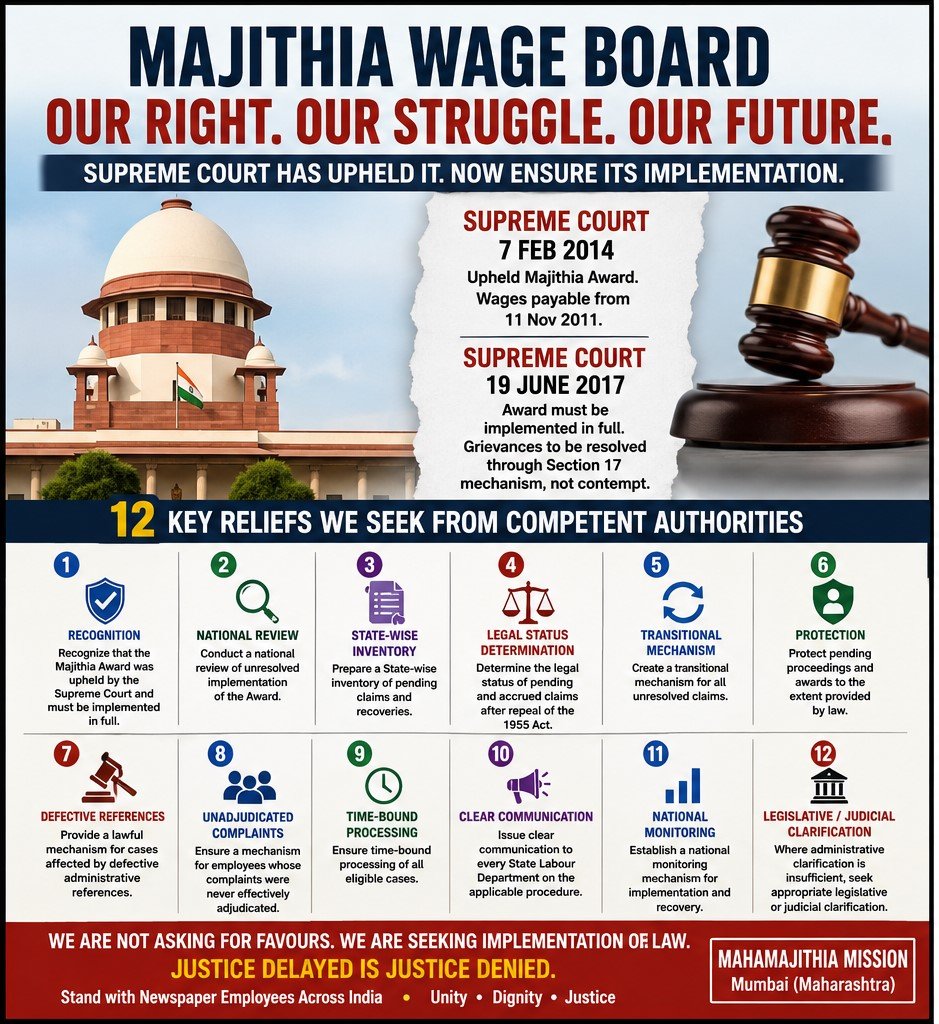
The Supreme Court had upheld the Majithia Wage Board recommendations and directed that eligible employees be paid revised wages and arrears. In subsequent proceedings, the Court made it clear that grievances concerning non-implementation of the award should ordinarily be pursued through the statutory mechanism provided under Section 17 of the Working Journalists and Other Newspaper Employees (Conditions of Service) and Miscellaneous Provisions Act, 1955.
The dispute involving a workman of Dainik Divya Marathi, Nagpur, subsequently passed through the Labour Court, the Bombay High Court and the Supreme Court. The Aurangabad Labour Court reportedly ruled in favour of the employees and directed payment of arrears arising from implementation of the Majithia Wage Board Award.
According to the case-specific account, the Labour Court proceedings culminated in an award dated January 4, 2019, directing payment of the wage difference and arrears. The employer’s subsequent review petition was reportedly dismissed on June 10, 2019.
The employer thereafter challenged the Labour Court award before the Aurangabad Bench of the Bombay High Court in Writ Petition No. 11665/2019. The dispute increasingly centred not only on the employees’ entitlement but also on the legal mechanism through which the award could be enforced and the arrears recovered.
The recovery proceedings assumed greater significance after the Bombay High Court reportedly directed issuance of a recovery certificate on March 23, 2022. The matter thereafter moved into the enforcement stage, involving the labour and revenue authorities.
In September 2022, the recovery process reportedly reached the newspaper establishment, with revenue authorities initiating attachment-related proceedings over non-payment of the arrears. The management subsequently approached the High Court, following which directions were issued concerning deposit of 50 per cent of the amount.
The prolonged proceedings ultimately resulted in approximately ₹1 crore being deposited in court in connection with the arrears claimed by the group of employees.
A significant legal issue arose in December 2022 when the employer challenged the proceedings on a technical and jurisdictional ground relating to Section 17(2) of the Working Journalists Act. The Bombay High Court subsequently passed an order adverse to the employees’ position on the issue and granted an eight-week period of protection.
The employees then approached the Supreme Court challenging the High Court’s decision. The matter came up before a Bench comprising Justice Dinesh Maheshwari and Justice Dipankar Datta on February 13, 2023.
A crucial issue before the Supreme Court was the money already deposited in court towards the employees’ arrears. The employer sought permission to withdraw the deposited amount, while the employees opposed such withdrawal and sought continuation of the interim protection.
The Supreme Court continued the interim protection and directed issuance of notice to the respondents. In practical terms, the order prevented the deposited amount from being withdrawn at that stage while the legal dispute remained pending.
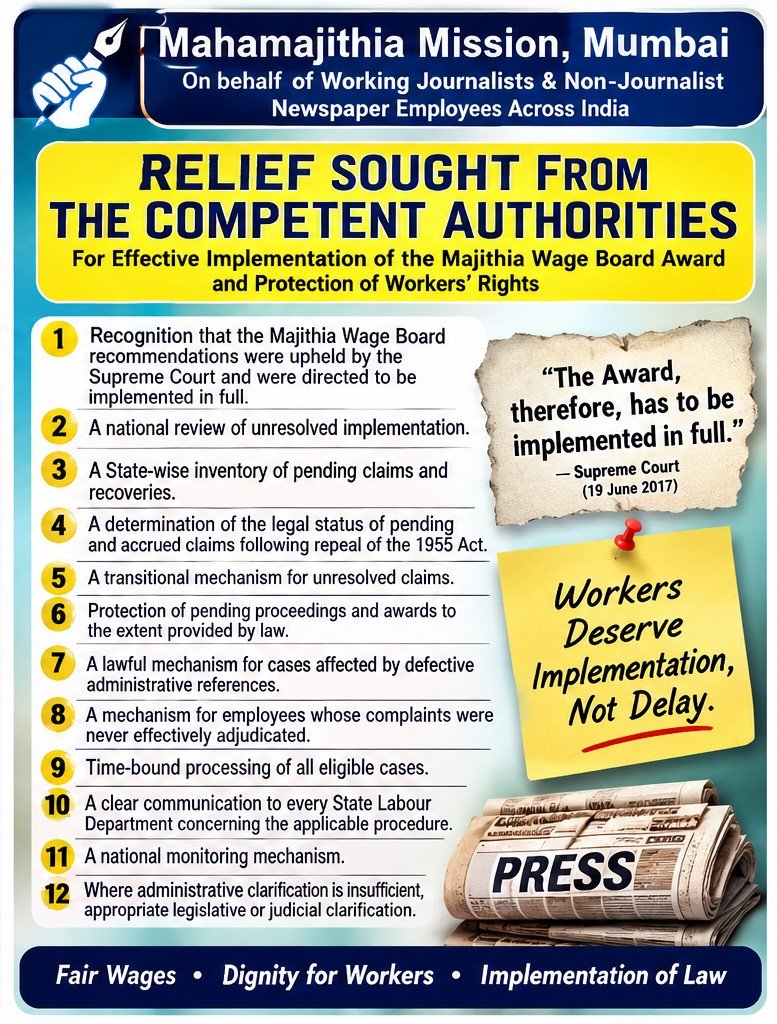
The significance of the development lies in the fact that the dispute is not fundamentally about the validity of the Majithia Wage Board itself. The Supreme Court had already upheld the wage-board recommendations. The subsequent litigation concerns their implementation, determination and recovery of arrears, the statutory procedure under Section 17, and the legal validity of the proceedings undertaken by the labour authorities.
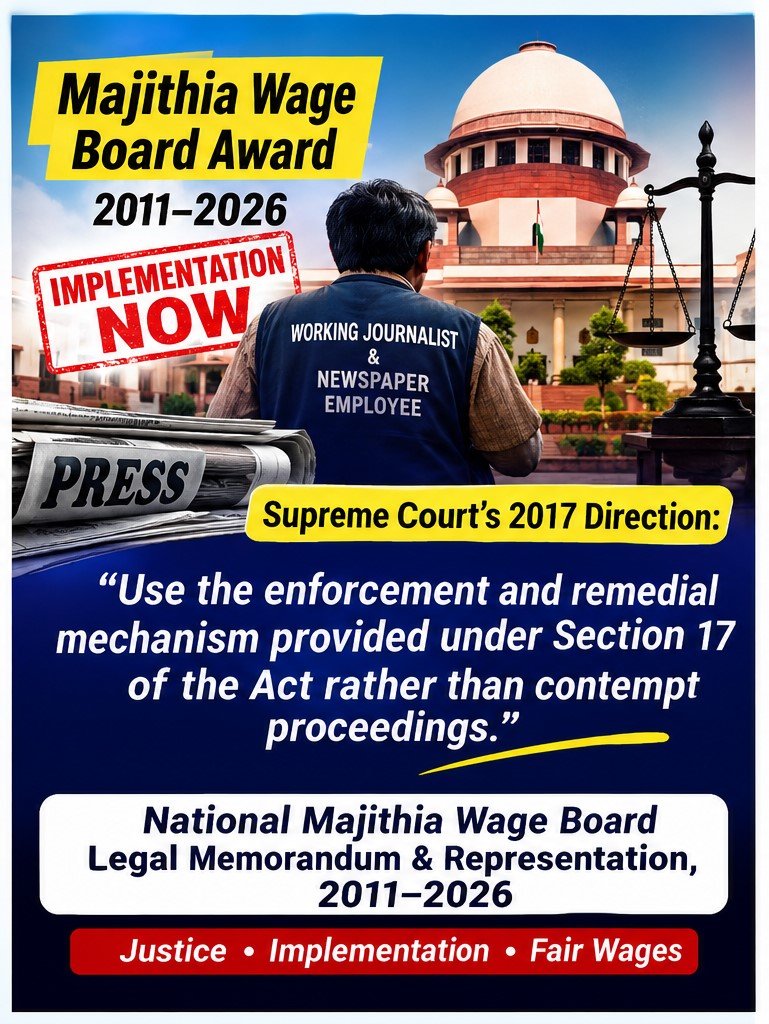
The Supreme Court had also emphasised in its broader Majithia litigation that Labour Courts and Industrial Tribunals dealing with references under Section 17(2) should proceed without unnecessary adjournments and endeavour to decide such matters within the six-month period indicated by the Court. High Courts were similarly requested to keep the prescribed time frame in mind while dealing with challenges to Labour Court and Industrial Tribunal orders.
This time-bound direction assumes particular significance in cases involving newspaper employees, for whom prolonged litigation can substantially delay the practical benefit of a wage entitlement that has already been recognised under the applicable legal framework.
The Supreme Court’s directions in the broader Majithia litigation effectively established a statutory route for employees alleging non-implementation: the grievance is to move through the labour authorities and the Section 17 mechanism, followed, where necessary, by adjudication before the Labour Court and subsequent judicial review before the High Court or Supreme Court.
From the employees’ perspective, therefore, the central issue has shifted from whether the Majithia Wage Board is legally valid to whether the benefits flowing from it can actually be enforced.
The Supreme Court’s February 2023 intervention provided significant interim protection because the approximately ₹1 crore deposited in court could not simply be withdrawn while the matter remained under judicial consideration. However, that interim protection should not be confused with a final judgment awarding the deposited amount to the employees.
As of the latest position reflected in the material reviewed for this report, no reliable official Supreme Court record has been identified establishing a new 2026 final judgment specifically disposing of the individual case involving the workman of Dainik Divya Marathi, Nagpur. Nor has a reliable official record been located establishing that the approximately ₹1 crore deposited in court has subsequently been released to the employees.
The available case material indicates that the employees obtained an important Labour Court award, faced a subsequent challenge before the Bombay High Court, pursued recovery proceedings and ultimately secured interim protection from the Supreme Court against withdrawal of the deposited amount.
The scribe is of the opinion that the distinction between an interim protective order and a final adjudication is particularly important in reporting the matter. Describing the development as a final victory or stating that the employees have already received the entire deposited amount would go beyond what the presently verifiable material establishes.
The case consequently remains significant not merely as an individual wage dispute but as another example of the continuing legal struggle surrounding implementation of the Majithia Wage Board Award and the practical enforcement of wage rights of employees working in newspaper establishments.
For the workman of Dainik Divya Marathi, Nagpur, and the other employees involved, the substantive question remains whether the recognised wage entitlement and arrears will ultimately translate into actual payment. The judicial record available for the present report establishes substantial progress in that direction, including the Labour Court award and protection of the deposited amount, but does not by itself establish final release of the money or final disposal of the individual Supreme Court proceedings.
Post your comments and suggestions to : __ editor@gramintimes.in
Leave a Reply