
By Ganesh Upadhyay
Kolkata, Saturday, 11 July 2026 – India witnessed a landmark moment in its political landscape as the Bharatiya Janata Party (BJP)—successor to the Bharatiya Jan Sangh—formed its government in West Bengal, the birth state of its founder, Dr. Shyama Prasad Mukherjee on 9th May 2026.
The newly sworn-in Chief Minister, Suvendu Adhikari, paid a respectful visit to the family of Dr. Mukherjee, underscoring the party’s deep sense of gratitude to its ideological architect. In a symbolic gesture, the Hon’ble Prime Minister Narendra Modi also sought blessings from Makhanlal Sarkar, the 97-year-old long-time associate of Dr. Mukherjee, further highlighting the emotional and historic significance of the occasion.
This milestone marks the culmination of a journey that began with Dr. Mukherjee’s vision decades ago—a seed that has now grown into a towering tree, spreading its influence across much of India. The crowning glory of this expansion is its establishment in West Bengal, the very birthplace of the founder, making the victory both politically and sentimentally profound.
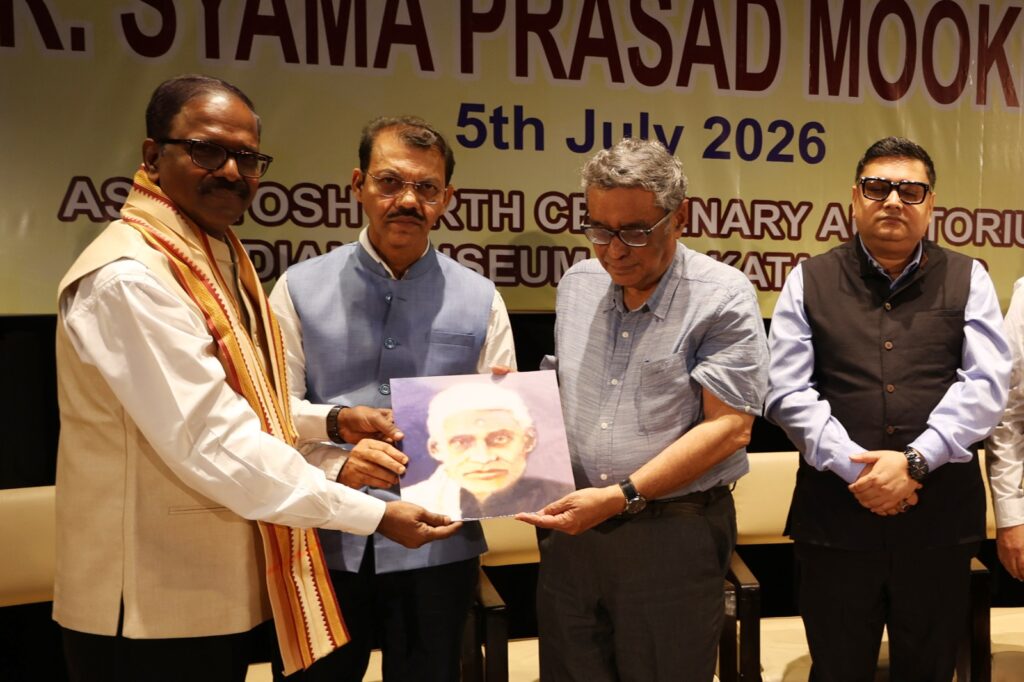
In this string of names one name that is conspicuously missing is that of the Pandit Narayana Mahapatra Kavyatirtha Shiromani of Odisha, the unsung yet no in-significant mentor who shaped the intellectual persona of Dr Shyama Prasad Mukherjee early on. Pt. Narayan was his Sanskrit home tutor, who had been especially chosen by none other than the illustrious Sir Ashutosh Mukherjee, the father of Dr. Shyama Prasad Mukherjee, and popularly known as the Royal Bengal Tiger. Sir Ashutosh was then the Vice Chancellor of Kolkatta University and Narayana was then a Post Graduate student of Sanskrit. Sir Ashutosh was himself a profound Sanskrit scholar, a great admirer of Indian knowledge system and classical Hindu view of life & philosophy. It was his desire that his son Shyama should be introduced to the Vedas & Vedantas. Sanskrit was the indispensable means to achieving this end. Thus started the search for an able Sanskrit teacher, and an Indologist, who would impart the knowledge to young Shyama and build a sound foundation on the tenents of Indian Knowledge System.
Sir Ashutosh then made a request to the then Head of the Department (HOD) of Sanskrit to suggest a name of a faculty who could fit the bill. As the anecdote goes, the HOD quipped that there was a PG student named Narayan who would do the job better than many faculties. Then Narayan was personally interviewed by Sir Ashutosh, and on being greatly impressed by the profundity of his knowledge, he was appointed the private teacher and mentor of young Shyama and one of his sisters, Amala. Thus began a new intellectual journey in the life of a young boy who was later to emerge as Dr. Shyama Prasad Mukherjee, as we know him today. This was a tryst with destiny that was well conspired by providence.
The teacher-pupil relationship between Pt. Narayan and Dr. Shyama Prasad continued to grow fonder through the passage of time. Though, Pt. Narayan joined as the Inspector, Sanskrit Education Circle for Eastern India under the British Govt., he soon quit the service on the request of Pt. Gopabandhu Das to serve the Odia speaking people scattered in the border areas of Odisha-Andhra. Thus, while Pt. Narayan left Kolkatta for south Odisha, Dr Mukherjee charted an inspiring political journey becoming the Finance Minister of Bengal in the progressive coalition Govt. of Fazlul Haque (1941-42) and then Industry and Supplies Minister of India in the interim Govt under Prime Minister Nehru. The relationship between the two, however, continued till Dr. Mukherjee breathed his last in June 1953 in Kashmir. Pt. Narayan passed away barely a year after that in April 1954.
Dr Mukherjee often used to visit Puri and would never miss the company of his Guru. He also used to visit Pt. Narayan’s native village Biraharekrushna Pur on the outskirt of Jagannath Puri and used to relish the traditional Odia delicacies. Dr Mukherjee is also known to have inspired Pt. Narayan to write an ‘Aadarsh Shradha Padhati’ which continues to be published by the Gopabandhu Sahitya Mandir, an outfit of the Samaj/the Lok Sevak Mandal, at Kataka (Cuttack).
As desired by Pt. Gopabandhu Das, Pt. Narayan went to Ichhapur, a small town in Odisha-Andhra border to help set up an Odia medium High School for the benefit of Odia speaking population in the area. The school was set up with the kind patronage of King of Surangi, and was a great success. He continued to serve there for 35 long years during which time he was actively assosiated with Utkal Sammilani. Young Krushna Chandra Gajapati, the king of Pralakhemundi, often used to consult him and take his advice. V.V. Giri, who later became the fourth President of India, used to drive down from Berhmpur to Ichhapur to learn Sanskrit from Pt. Narayan. During this period he was also assosiated with the Madras University for 28 long years in various capacities including Head Examiner and paper setter for PG Sanskrit exams. He was also the publisher and editor of a bi-weekly Odia magazine ‘Dharmaduta’. During this period he also authored many scholarly books like, ‘Adarsha Vyakarana’ in two parts which were then prescribed text books in schools. ‘Bhasha Sudhi Chandrika’ was meant to purge common mistakes occurring in spoken and written Odia. His ‘Panchabhakta Kavita’, ‘Keshaba Koili’ with annotation were part of PG curriculum. His ‘Prathamika Chikitsa’ was a very popular first-aid primer in every house hold.
After serving for about three and a half decades to the scattered Odia speaking people in south Odisha-Andhra border, Pt. Narayan relocated to his native village, Biraharekrushna Pur, near Puri town in the year 1946. When his modest house was gutted and reduced to ashes, he had to move to a rented house in Nua Sahi, Puri Town.
As mentioned earlier, Pt. Narayan had quit regular Govt. service as an Inspector to opt for an uncharted path of setting up a new school on a private initiative. When he retired from the school there was no pension as the school was yet not taken over by the Govt. So, when Pt. Narayan returned to Puri after 35 years, his financial condition was precarious. Realising this, Pt. Nilakanth, Pt. Godabarish and Pt. Lingaraj tried to help Pt. Narayan in setting up a history and heritage research institution ‘Nikhila Utkala Gabeshana Karyalaya’ with a grant from the Govt. of Odisha. He was appointed as the ‘Pandit Gabeshak’. This institution started functioning from a rented premises near Dakshina Kali temple at Puri. Sh Gadadhar Ramanuja Das, the abbot of Emar Math was closely assosiated with this institution. Pt. Sadasiba Ratha-Sharma was his Research Assistant to help collect palm leaf manuscripts for research. In a way this was one of the earliest initiatives to document traditional knowledge base long before the term became popular. The Institute embarked on an ambitious research journey culminating into collection of a large number of rare plam-leaf manuscripts and their publication. Notable among them was a rare text ‘Shilpa Chandrika’. This book meticulously depicts the detailed architectural planning, design and construction of Shri Jagannath Temple. Unfortunately, after the death of Pt. Narayan in April 1954, the Govt stopped grant to the Institute questioning the qualification of Pt. Sadasiba. According to Dr. Surendra Mishra, a well-known history and heritage scholar, is the institute had continued, it could well have emerged as another institution of the stature of Asiatic Society of Kolkata or the Saraswati Pathagar of Varanasi.
Besides the above, Pt. Narayan was also actively associated with the prestigious scholarly institution attached to Lord Jagannath Temple known as Mukti Mandap Pandit Sabha. He had painstakingly organised the ancient Library of the Pandit Sabha which continues to exist till date. As a learned member of the Vyavastapak Parishad of the Mukti Mandap Pandit Sabha he used to help interpret complex religious and theological references in terms of Vedic texts & tenets. His intellectual engagements and dialogues with Acharaya Harihar is anecdotal. The inspiration for the ‘Adarsha Shradha Padhati’ is also credited to Acharay Harihara. Dr Radhanath Rath, the then editor of the Samaj had kindly got the book published through Gopabandhu Sahitya Mandir. His handwritten manuscript ‘Utkal Itihasa’ has not yet seen the light of the day.
On his sudden demise on April 1954, came the end of the saga of struggles, academic glory and personal sacrifice for public cause. With his passing also came the end of a promising research institution on history and heritage. He was truly an epitome of a great sanskrit scholar, an admired teacher, a historian, a social reformer, an worthy descendant of famous Smritikar Godadhar Rajguru and early freedom fighter Shaheed Jayee Rajguru, and above all an unwavering patriot who dedicated his entire life to the service of the society.
__editor@gramintimes.in


Leave a Reply