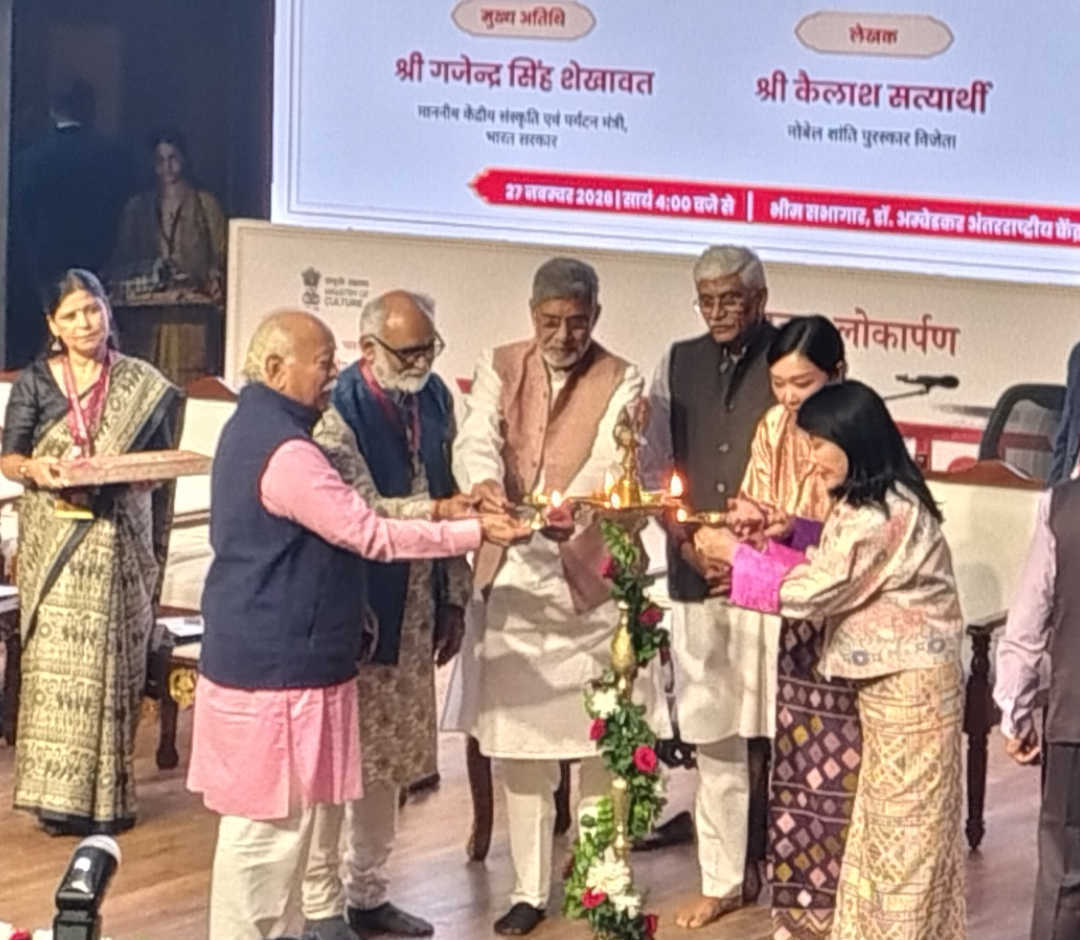
Mohan Bhagwat releases Nobel laureate’s book at New Delhi ceremony; Gajendra Singh Shekhawat and Bhutan’s Princess Sonam Dechen Wangchuck underline the relevance of Lord Ram’s ideals in contemporary society
Worshipping Lord Ram is meaningful, but following his ideals in everyday life is equally important. This powerful thought formed the philosophical centrepiece of the launch of ‘Karunanayak Ram’, a new book by Nobel Peace Prize laureate Kailash Satyarthi
By Ganesh Upadhyay
NEW DELHI, 27 November, Friday: Worship of Lord Ram is an act of faith. To live by his ideals is a sterner test of devotion. That distinction formed the philosophical centre of the launch of Karunanayak Ram, the new book by Nobel Peace Prize laureate Kailash Satyarthi, released here on Friday by Dr Mohan Bhagwat, Sarsanghchalak of the Rashtriya Swayamsevak Sangh.
The ceremony was held at the Bhim Sabhagar of the Dr Ambedkar International Centre. It was organised by the Indira Gandhi National Centre for the Arts, under the Ministry of Culture. The book has been published by Prabhat Prakashan.
The gathering included Gajendra Singh Shekhawat, Union Minister for Culture and Tourism, who attended as chief guest, and Princess Sonam Dechen Wangchuck of Bhutan, who attended as guest of honour, accompanied by her mother, Ashi Dorji Wangmo Wangchuck. Their presence lent the occasion a cultural, social and diplomatic significance beyond that of an ordinary literary function.
The central proposition of the book is plain. Ram ought not to be confined to the temple, to ritual, or to devotional utterance. He ought to be understood as an enduring embodiment of compassion, sacrifice, dignity, justice and concern for the welfare of all. His life, Satyarthi argues, offers a standard by which men may judge their conduct in the family, in society, in institutions and in governance.
From Devotion to Duty: In his address, Satyarthi invited the audience to look beyond conventional devotion and to examine the values that have rendered Ram an abiding ideal for humanity.
“If we behold Ram in his compassionate form, there is much we may learn from him. What connects all men to Ram is his compassion, the same compassion that dwells within each of us. Compassion is the essence of Ram. Ram is the embodiment of compassion,” he said.
The laureate posed a question of considerable force. If millions worship Ram, why do so few endeavour to incorporate his ideals into daily conduct? By placing Ram solely upon a divine pedestal, he argued, society often transfers to God the responsibility for ending injustice, rather than accepting that responsibility itself.
For Satyarthi, the life of Ram affords practical instruction in confronting suffering, discrimination and inequality. Compassion, in this reading, is not passive sympathy. It is not a fleeting emotion aroused by the sight of distress. It is an active commitment to comprehend suffering and to take concrete steps to alleviate it.
That understanding has shaped his own work. For more than five decades he has campaigned for the rights of children, for freedom from exploitation, and for access to education. His philosophy, as expressed in the book, is therefore not abstract. It derives from sustained engagement with poverty, bondage and social exclusion.
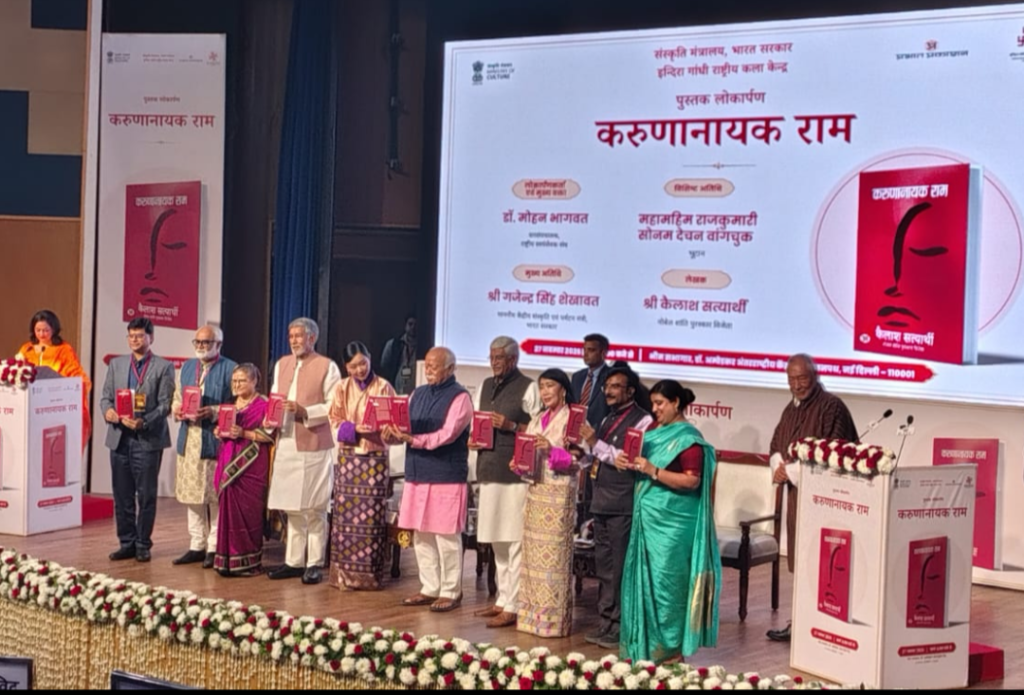
Dr Bhagwat, in his keynote address, placed the message of the book within the context of contemporary division, international conflict and growing individualism. He held that the absence of compassion was the fundamental cause of the troubles that confront humanity, irrespective of geography or period.
“Whether it be a problem of this country or of another, of the present, of the past, or of the future, the root of all such problems lieth in one place: in the absence of compassion,” he observed.
He expressed particular appreciation for Satyarthi’s conception of the “globalisation of compassion”, a phrase he said he had first heard from the laureate. The world, he maintained, stood in urgent need of such a conception.
Drawing a contrast between Ram and Ravan, Bhagwat explained that their essential differences lay in attitude. Ravan represented ahankar, or ego. Ram embodied karuna, or compassion. Ego, he said, is the inability to move beyond the narrow bounds of “I and mine”. It prevents a man from perceiving his connection with others.
Despite differences of appearance, conduct and identity, humanity and the wider universe are interlinked. To recognise that inner unity, Bhagwat suggested, is essential if division and conflict are to be overcome.
Compassion, he added, is not an extraordinary virtue. It is a natural human response. “It is natural in the heart of each one of us to feel moved to do something to relieve another man’s suffering. That is our compassion,” he said.
He further observed that individual and national well-being cannot be separated from the well-being of the wider world and of the environment. Wars and conflicts, he suggested, arise from narrow self-interest and from a failure to recognise this interconnectedness.
Referring to India’s civilisational responsibility, he called for a wider sharing of its values with the world. “This is India’s turn to give,” he said.
His address thus gave the book a contemporary dimension. At a time when the world witnesses war, geopolitical tension, social division and increasing self-regard, neither material prosperity nor power alone can ensure lasting peace. What is required is a transformation in human attitude, beginning with compassion.
Princess Sonam Dechen Wangchuck brought an international perspective to the discussion. She congratulated Satyarthi and appreciated his endeavour to connect the ideals of Ram with contemporary humanitarian values.
“Bhutan feels greatly honoured that Satyarthi has called our country a good example of Ramrajya,” she said.
She commended young persons who are coming forward to understand and embrace the ideals of Ram. She particularly appreciated Satyarthi for transforming courage into compassion, and she emphasised that compassion ought never to be mistaken for weakness.
Her remarks carried a significant implication. In a world where strength is frequently equated with authority, influence and power, the book offers a different understanding. True strength, it suggests, is displayed through the capacity to care, to empathise, and to act for the welfare of others.
Her observations also connected the philosophy of Ram with Bhutan’s understanding of harmonious living and collective well-being. The presence of the Princess lent an important India-Bhutan cultural dimension to the gathering, and her reference to Bhutan as an example of Ramrajya was received with marked appreciation.
Shekhawat, the chief guest, congratulated Satyarthi upon completing the book and praised his effort to bring forth the compassionate character of Lord Ram.
Emphasising the relation between authority and moral responsibility, he said that power becomes meaningful only when it is supported by compassion.
He expressed the hope that the book would inspire the younger generation to incorporate greater compassion and humility into their manner of living. He also underlined the enduring relevance of Ram’s character, particularly his compassion, sacrifice, adherence to maryada, or ethical conduct, social harmony and commitment to public welfare.
His message reinforced the central proposition of the publication: the ideals represented by Ram must find expression in the conduct of individuals and of institutions. Cultural bodies, he implied, bear a responsibility to render India’s intellectual and spiritual traditions intelligible and relevant to younger audiences.
One of the principal contributions of the book is its exploration of compassion across four dimensions: the family, society, institutions and the self.
Satyarthi revisits notable episodes from Ram’s life to illustrate each dimension. He examines Ram’s acceptance of exile, his endurance of personal loss, and his conduct following victory over Ravan.
Among the episodes discussed is Ram’s meeting with the boatman, whom he embraces and treats with dignity at a time when birth and social rank often determined a man’s worth. The book also offers a fresh perspective upon Shabari, portraying her not merely as a helpless devotee, but as a woman of knowledge who took initiative.
Another episode of particular significance is Ram’s decision to entrust the kingdom of Lanka to Vibhishan after the defeat of Ravan, rather than to claim the conquered territory for himself. For Satyarthi, this reflects a leadership ethic rooted in restraint and compassion rather than in personal ambition.
Through these narratives, the author invites readers to examine leadership through the lens of responsibility rather than entitlement, and strength through the lens of service rather than domination.
A Vision of Ramrajya
Beyond individual morality, Karunanayak Ram engages with the larger question of what an ideal society ought to be.
Satyarthi’s interpretation of Ramrajya extends beyond conventional descriptions of an ideal kingdom. It is a vision of governance in which compassion becomes the foundation of public policy and institutional conduct. Justice, equality, transparency and accountability are central to this vision. The author also emphasises respect for nature and the right of every citizen to question the ruler without fear.
This interpretation carries particular significance in light of Satyarthi’s longstanding work for children and marginalised communities. His experience has repeatedly shown that injustice cannot be removed by sympathy alone. It requires persons, communities and institutions to accept responsibility.
The book therefore seeks to connect the moral teachings associated with Ram with contemporary questions of social justice, responsible leadership, inclusive development and human dignity. It imagines a society wherein governance rests upon compassion, and wherein citizens enjoy the freedom to dissent without apprehension.
In this sense, Ramrajya is not presented as a distant golden age. It is presented as a standard by which present institutions may be judged.
The launch brought together three distinct yet complementary perspectives: Bhagwat’s emphasis upon the universal need for compassion, Satyarthi’s experience of translating humanitarian values into social action, and Shekhawat’s emphasis upon the continuing relevance of India’s cultural heritage. The remarks of Princess Sonam Dechen Wangchuck further reinforced the universal character of the message.
The presence of these distinguished persons rendered the occasion more than a conventional book release. It became a deliberation upon the meaning of leadership, the responsibility of the individual, and the values required to build a harmonious society.
The programme was organised in association with the Ministry of Culture and the IGNCA. Prabhat Prakashan, the publisher, has presented the work as a contribution to contemporary reflection upon India’s philosophical inheritance.
Perhaps the most important conclusion to be drawn from the launch was the distinction between celebrating an ideal and practising it.
India possesses a long tradition of devotion to Lord Ram. Satyarthi’s work, however, asks the reader to proceed a step further. Can Ram’s compassion be reflected in our treatment of children, in our response to discrimination, in our conduct towards the disadvantaged, and in our approach to public responsibility?
Can institutions become more humane? Can those in authority exercise power with humility? Can society move beyond narrow identities and recognise the suffering of others as a shared responsibility?
These questions confer upon Karunanayak Ram its contemporary significance. The book’s message also accords with Satyarthi’s larger advocacy for the globalisation of compassion, a philosophy that seeks to render empathy and human dignity central to the functioning of society.
As the ceremony concluded, the message that emerged from the deliberations was clear. The ideals of Ram must not remain confined to religious observance or philosophical discourse. They must become visible in everyday action, in social relations, in public institutions and in leadership.
For Kailash Satyarthi, the true tribute to Ram is not merely to worship him, but to practise his compassion. That, perhaps, is the most enduring message of Karunanayak Ram.
In an age marked by conflict and estrangement, the book offers a simple yet exacting standard: devotion acquires depth when it is expressed in deeds. People from all walks of life, including the elite of Delhi, were present on the occasion, and the hall was packed to capacity. Brisk sales of the book were recorded at the reception area, with attendees eagerly seeking autographs from the Nobel Peace Laureate.
Leave a Reply