
By Ganesh Upadhyay
Rajgir, Bihar | Monday, 21 September 2026: The Governor of Bihar, Syed Ata Hasnain, inaugurated a two-day national symposium on ‘Role of Indian Knowledge Traditions in Building a Developed India’ at Nalanda University. Organised with the Shiksha Sanskriti Utthan Nyas, the conclave unites Vice Chancellors, Directors, academicians and researchers to connect ancient wisdom with modern development goals.
Addressing as Chief Guest, Lt Gen Hasnain stated there could be no more appropriate place than Nalanda to discuss Indian Knowledge Traditions (IKT) and the vision of a developed India. He described the region—encompassing Nalanda, Rajgir, Bodh Gaya, Vaishali and Vikramshila—as a vast civilisational geography of knowledge and intellectual exchange.
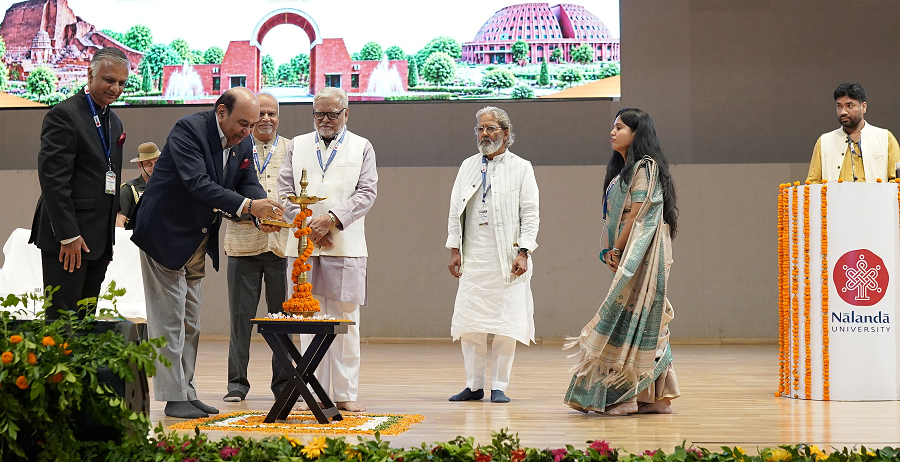
The Governor stressed that knowledge is central to national power and technology. “A developed India must move towards becoming not merely a consumer of knowledge but also a creator of knowledge,” he asserted. Citing contributions in mathematics, astronomy, medicine, philosophy, linguistics, metallurgy and governance, he cautioned that mere remembrance of tradition is insufficient. Instead, he called for engaging tradition with contemporary questions and establishing a serious dialogue with modern science, while developing Indian languages as mediums for research and innovation.
Outlining the ‘Nalanda Approach,’ the Governor highlighted India’s civilisational strength in building global partnerships through scholarship. He praised university initiatives like Nalanda Spirit, Shastrartha and Sahabhagita for connecting knowledge with society. “Ancient Nalanda is India’s heritage, while the Nalanda of the future should be our ambition,” he declared, envisioning a hub where global scholars collaborate on challenges like climate change, disaster resilience, public health and ethics.
Vice Chancellor Professor Sachin Chaturvedi introduced the theme by arguing that the question is not whether IKT is relevant, but how to advance it. He urged viewing these traditions as a shared heritage of South and wider Asian civilisation rather than confining them to national boundaries. Prof Chaturvedi advocated for an interdisciplinary approach over siloed disciplines, emphasising evidence, reasoning and respect for diverse perspectives. Referencing the Nalanda tradition of Shastrartha, he noted its purpose was collective knowledge expansion through dialogue, not debate victory, linking IKT to global peace and pluralism.
Eminent educationist Professor Ramesh Bhardwaj underscored the National Education Policy 2020’s role in making education India-centric. He called for restoring knowledge traditions through evidence, literary sources and archaeological findings, noting the Shiksha Sanskriti Utthan Nyas’s efforts in promoting IKT centres nationwide.
Former UGC Vice Chairman Professor Bhushan Patwardhan urged that IKT be viewed not just as pride or heritage, but as a living source of insights for current challenges. He stressed that students must engage with ancient traditions in contemporary contexts to unlock their innovative potential.
Dr Atul Kothari, National Secretary of Shiksha Sanskriti Utthan Nyas, linked IKT to solving global crises like environmental degradation and mental health issues. Citing yoga’s holistic balance, he called for deeper integration of these traditions into research and nation-building.
Leave a Reply