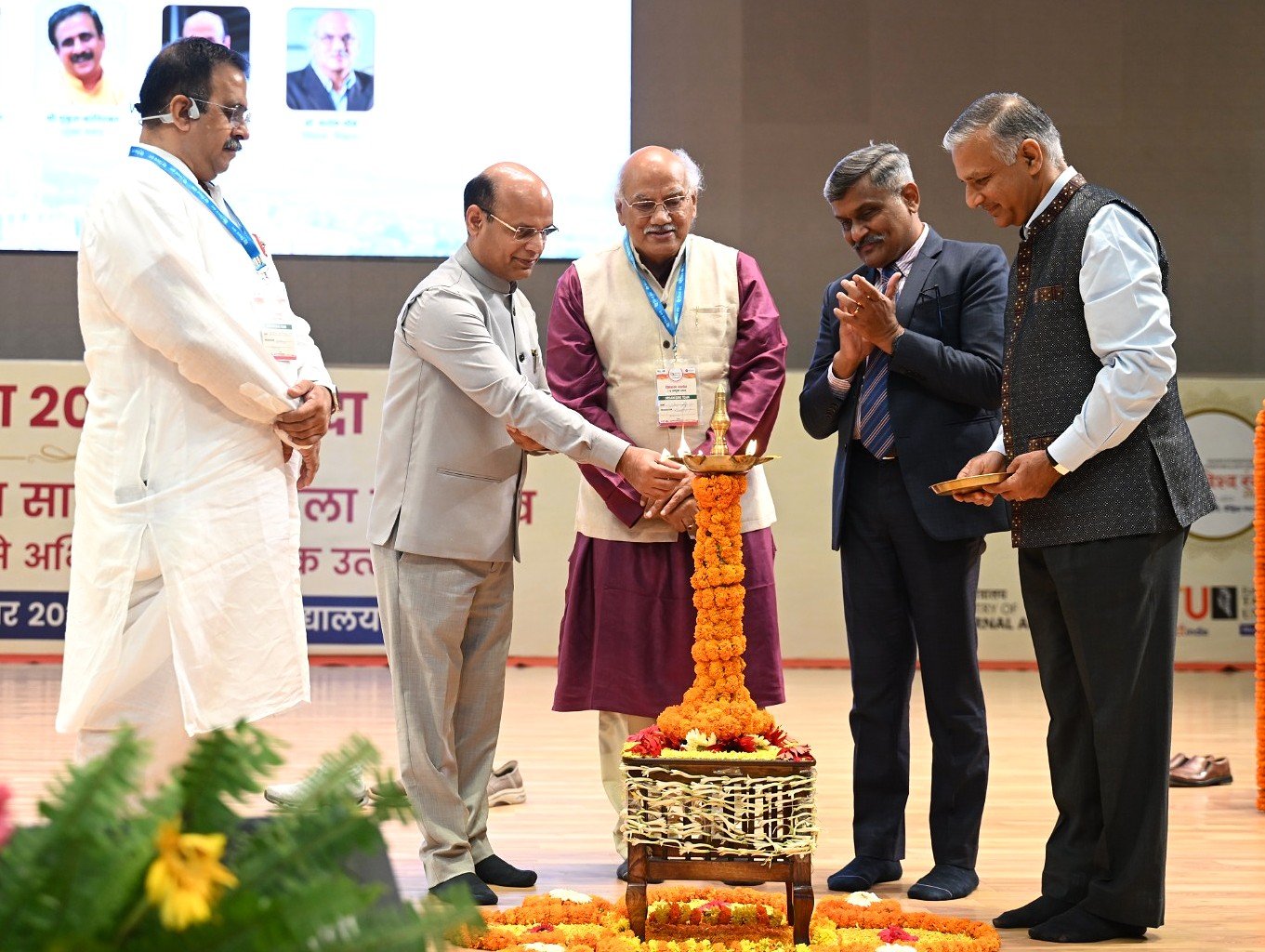
Vishwarang Nalanda 2026 Begins with Focus on India–Asia Dialogue: It was inaugurated at Nalanda University, Rajgir, on Wednesday, 7 October 2026, to deepen dialogue between North-East India and South-East Asia through language, literature, culture and the arts. The two-day programme will conclude on 8 October.
By Ganesh Upadhyay
Rajgir, Nalanda, Bihar, 7 October 2026: Vishwarang Nalanda 2026 was inaugurated at Nalanda University on Wednesday around the theme, “North-East India and South-East Asia: Dialogue through Language, Literature, Culture and the Arts.” The programme aims to explore historical and contemporary links between India and Asia while creating new opportunities for academic, cultural and civilisational engagement.
The event is being jointly organised by Vishwarang Foundation, Bhopal; Rabindranath Tagore University, Bhopal; and Nalanda University. The inaugural session was addressed by Hon’ble Vice Chancellor of Nalanda University Professor Sachin Chaturvedi, Dr Santosh Choubey, Director, Vishwarang; Dr Rajesh Ranjan, Deputy Director General, Indian Council for Cultural Relations (ICCR); Shri Katikithala Srinivas, IAS, Secretary, Ministry of Development of North Eastern Region, Government of India; and noted thinker and Chief Speaker Shri Mukul Kanitkar.
The ceremony opened with a film presentation on Nalanda and Vishwarang, followed by Vedic Swastivachan and the lighting of the ceremonial lamp. In his thematic address, Professor Sachin Chaturvedi described the programme as a natural extension of the Nalanda spirit. He said Nalanda represented not merely a university but a source of knowledge and consciousness. He also highlighted collaboration with Bhashini for real-time translation of Hindi addresses into English and Sanskrit.
Professor Chaturvedi underlined the importance of strengthening university, cultural, scientific and historical links through Nalanda University’s Centre for South-East Asian Studies. He said meaningful Asian connections required people-to-people contact, knowledge traditions and cultural understanding alongside physical infrastructure.
Dr Rajesh Ranjan described North-East India as a vital cultural bridge to South-East Asia. He referred to linguistic interactions involving Bodo, Assamese, Manipuri, Khasi and Naga languages with Sanskrit, Pali, Burmese and Thai. He also highlighted literature, songs, student movement and ICCR scholarships as important channels of cultural exchange.
Dr Santosh Choubey invoked Vasudhaiva Kutumbakam, “Vishuddha Vishwamitra” and Rabindranath Tagore’s vision of a fearless mind and free knowledge. He stressed the equal dignity of all languages and called for an open, dialogue-oriented society.
Chief Guest Shri Katikithala Srinivas, IAS, described the North-East as an important “hinge” between India and South-East Asia. He emphasised language as a carrier of culture, memory, ethical values and traditions, and linked the programme with the Act East approach. He also called for digitally preserving India’s knowledge traditions and assured full cooperation from the Ministry of Development of North Eastern Region.
Keynote Speaker Shri Mukul Kanitkar said the revival of Nalanda must restore its tradition of sharing knowledge with the world. He highlighted diversity, inclusiveness, renunciation and universal brotherhood, and urged the preservation of linguistic and cultural plurality in the age of technology and artificial intelligence.
Academic sessions will discuss South Asian and Indian language interconnections, translation and language coordination, economic and cultural consciousness in the North-East and South-East Asia, and Nalanda’s knowledge tradition. A Gurudev Rabindranath Tagore exhibition has also been inaugurated, followed by a Rabindra Sangeet evening. The programme will conclude on 8 October with multilingual poetry recitations and musical performances.
Comments and Suggestions to editor@gramintimes.in
Leave a Reply